

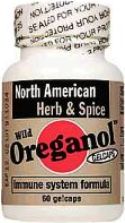
Oreganol aka Oregagels - 60 SG by North American Herbs
Sale Price: $26.99
You Save: ()
| Qty | 1 - 2 | 3 - 5 | 6 - 11 | 12+ |
| Price | $26.99 | $26.39 | $26.03 | $25.67 |

SKU: NOR725
MPN: 066
UPC: 635824000501
Oreganol Gelcaps by North American Herbs from a pure, edible essential oil that is cold-pressed, steam distilled and made from a blend of four high-mountain, wild oregano plants. The pure Oreganol P73 oil is then emulsified in a carrier of extra virgin olive oil. Oil of Oregano has anti-fungal, anti-bacterial, germicidal, antiseptic, pain-killing, and antioxidant properties.
Questions/Studies/Research
1. What types of research has been conducted using Oregano P73?
More than thirty major research projects have been conducted to date. Here are a few highlights:
Scientists at the Georgetown University Medical Center in Washington, D.C. presented their findings from research using Oil of Oreganol P73 from North American Herb and Spice at the American College of Nutrition s 42nd Annual Meeting in October 2001. Led by Dr. Harry Preuss, professor of physiology and biophysics at Georgetown, the team tested the effects of the essential oil on the common bacteria Staphylococcus aureus (staphylococcus aureus is usaully found in the lower intestines of humans and commonly resides in the nasal passages and certain parts of the skin) , which is becoming more drug resistant and is the culprit in many modern-day infections. According to the Life Extension Foundation, in one in vitro study oregano oil was compared to the drugs streptomycin, vancomycin and penicillin and was found to inhibit Staphylococcus growth as effectively as these pharmaceutical antibiotics.
The team that conducted the research at Georgetown University s Medical Center included Vijaya Manohar, Cass Ingram, Judy Gray, Nadeem A. Talpur, Bobby W. Echard, Debasis Bagchi and Harry G. Preuss. The journal article entitled Antifungal Activities of Origanum Oil Against Candida albicans” states that the daily oral administration of Oil of Oreganol P73 (North American Herb and Spice, Waukegan , Illinois) may be highly effective in the prevention and treatment of candidiasis.
The oregano in Oreganol P73 has been tested by Jennifer Billing and Paul W. Sherman (Section of Neurobiology and Behavior) of Cornell University in Ithaca, New York. They discovered that oregano killed 100% of the thirty species of bacteria ( in vitro) it was tested against. This list included Pseudomonas aeruginosa, Listeria monocytogenes, Staphylococcus aureus and albus, and Bacillus anthracis (one type of anthrax species).
In volume 44 of the Journal of Agricultural Food Chemistry, researchers from the University of Thessaloniki in Greece published an article entitled Antimicrobial and Cytotoxic Activities of Origanum Essential Oils.” They discovered that oregano was highly bactericidal (it kills bacteria) at 1/4000 dilution and even at dilutions as high as 1/50000 caused a considerable decrease in bacterial growth rates. The same essential oil also exhibited high levels of cytotoxicity against four permanent animal cell lines ( in vitro) including two derived from human cancers.
The book entitled Beyond Antibiotics: Healthier Options for Families, by Michael A. Schmidt, Lendon H. Smith and Keith W. Sehnert, has an entire section devoted to the antimicrobial (antibacterial, antifungal and antiviral) efficacy of essential plant oils. In this section they state that one of the advantages essential oils have over antibiotics is that bacteria do not develop resistance to essential oils.” Many essential oils exert their antibacterial effect by interfering with the bacterias ability to breathe. On the other hand, antibiotics interfere with life cycle or metabolism of bacteria, but since bacteria are very crafty creatures, they change their chemistry and genes which makes the antibiotic less effective the next time it is used. So new generations of antibiotics will need to be developed to stay ahead of these organisms. Additionally, another advantage to essential oils is that some actually stimulate immune function.” Drs. E. Gildemeister and F.R. Hoffmann are referenced in the book as testing the antimicrobial efficacy of certain essential oils as compared to a medium, phenol. Phenol is an antiseptic substance found in Lysol, Pinesol and Chloraseptic throat spray. The findings were quite a surprise to the investigators. Oil of oregano was the most potent antimicrobial essential oil tested by the investigators, as it proved to be 21 times stronger than the medium. The two powerful phenols identified in Oregano P73 are carvacrol and thymol. The carvacrol and thymol content of every lot of Oregano P73 are tested to assure maximum potency without toxcitity.
Below are the results of how Oregano P73 tested in potency (in vitro) against other essential oils.If the essential oil had a reference number of 1.0, it was equal to the killing power of phenol. Any number above 1.0 indicates the antiseptic power of the essential oil beyond that of phenol.
Phenol………………………………………1.0
Lavender……………………………………1.6
Lemon………………………………………2.2
Citral………………………………………..5.0
Clove……………………………………..…8.0
Thyme............................................13
Oregano………………………………..……21
Volume 18 of the British Naturopathic Journal included an article entitled Kill and Cure: The Healing Properties of Wild Oregano Oil.” In the article David Potterton, ND summarized the findings of the world s foremost expert on oil of oregano, Dr. Cass Ingram. According to Dr. Ingram, oregano is the" Rolls Royce" of natural antiseptics. It is, for example, far more active against noxious urinary pathogens than the typically relied upon natural compounds such as garlic, goldenseal and echinacea. The active ingredient, carvacrol, acts directly upon the mucous membranes of the urinary tract and bladder. It offers the unique advantage of destroying both urinary bacteria as well as yeasts, something that standard antibiotics fail to achieve.” In addition, according to the article, readers should get their hands on a copy of Dr. Ingram s book The Cure is in the Cupboard: How to use Oregano for Better Health.
One of Dr. Ingram s predecessors, renowned scientist,.H. Martindale, documented that the essential oil of oregano was the most powerful plant-derived antiseptic known. This was back in 1910 when oregano was commonly used to treat illness. Mr. Martindale showed that oregano was 26 times more active as an antiseptic than phenol, a powerful disinfectant used to sterilize hospital equipment.
In 1977 at the Second International Congress of Phytotherapy and Aromatherapy Conference in Monaco, a French doctor named Belaiche unveiled his oregano index, which uses oregano oil as the base reference for comparing the bactericidal action of other substances. The reason he chose oregano oil was because he determined by rigorous laboratory experimentation that out of all natural essential oils, oregano was the closest to an ideal antibacterial agent. Belaiche used the analytical technique of Schroeder and Messing, who measured in millimeters the halo” of bacterial inhibition caused by specific essential oils in a bacterial culture medium maintained in petri dishes. He tested the ability of essential oils to inhibit bacterial growth as well as to kill bacteria. Belaiche chose to use bacterial cultures from sick persons rather than cultures grown in laboratories. He tested essential oils on up to 90 different types of bacteria. Based on these experiments, Belaiche and other French doctors developed an Aromatogramme,” a chart which measures the halo of inhibition caused by different essential oils on specific bacterial cultures. After the studies had been completed Belaiche concluded that This aromatic essence (oregano) is almost always the leader. Among the most active oils oregano is the ‘best of the best. The essential oil of oregano has always provided me with amazing results in treating infectious diseases. Besides oregano oil s bactericidal action, it also prevents spasms, convulsions and nervous disorders. In my estimation, the antispasmodic qualities help to synergize its wonderful antiseptic powers, which comforts me every time I prescribe it for my patients.” For the complete guide to aiding numerous ailments with oregano, including allergies, asthma, bronchitis, candidiasis, colds, cold sores, diarrhea, the flu, gastritis, psoriasis, sinusitis and dozens of others, consult Dr. Cass Ingram s book The Cure is in the Cupboard.
In the article A Serenade for Marinade” published July 5, 1999, in the Knoxville News (Health and Science section), Dr. F. Ann Draughon, a University of Tennessee microbiologist, studied the effects of herbs on food safety. Dr. Draughon found that oil of oregano was the most effective at killing all pathogens tested against, including nine food-borne microbes: Listeria monocytogenes, Staphylococcus aureus, Escherichia coli (commonly known as E-coli), Yersinia enterocolitica, Pseudonomas aeruglinosa, Lactobacillus plantarum, Aspergillus niger, Geotrichum and Rhodotorula.
Dr. Draughon, co-director of the UT Food Safety Initiative, said she approached the project full of skepticism. Sixty days later - when a piece of raw fish still smelled fresh - Draughon began to believe in the power of spice.
I was interested in doing something like this because of all the newspaper information on ‘nutra-ceuticals, or beneficial herbal supplements,” said Draughon, who headed the research team.
I wanted to show that using any kind of herbs was a useless endeavor, and I actually didn t think they would have any effect at all. So I went into this from the standpoint of doing something to show an approach doesn t work, instead of that it will. But they were so effective it totally changed my thinking. I was actually kind of shocked.”
The Tennessee Food Safety Initiative is a research program jointly supported by the U.S. Food and Drug Administration (FDA) and the UT Agricultural Experiment Station. To download this editorial please follow the link.
2. Has Oregano been tested and evaluated by the U.S. Department of Agriculture?
Yes. Oregano had 3 to 20 times higher antioxidant activity than the other herbs studied.
Researchers at the U.S. Department of Agriculture have determined that herbs are higher in antioxidant levels than fruits, vegetables and even spices such as garlic. Shiow Y. Wang, a biochemist at the USDA s Beltsville Agricultural Center in Beltsville, Maryland, stated in the November issue of the Journal of Agricultural and Food Chemistry that the herb oregano had 3 to 20 times higher antioxidant activity than the other herbs studied.” Additionally, oregano has 42 times more antioxidant activity than apples, 30 times more than potatoes, 12 times more than oranges and 4 times more than blueberries. This is an amazing discovery when considering the health benefits derived from consuming herbs like oregano.
So what does this all mean for the general public? Antioxidants have become a synonym for good health in recent years. This is because antioxidants are a class of components that fight off the charged molecules known as free radicals, which cause chemical damage in the human body. Free radicals are atoms or groups of atoms that cause damage to cells, which can lead to an impaired immune system and infections. Free radicals are also associated with degenerative diseases such as heart disease and cancer. Our bodies produce free radicals as part of the everyday metabolic breakdown of foods we eat. Excess free radicals are generated by exposure to radiation, rancid oils (fried foods), food additives (food coloring, sugars), chemicals (pesticides, nitrates added to cured meats) heavy metal pollutants, exposure to UV rays from the sun and smoking. According to researchers at the USDA, the destruction of free radicals may help fight the occurrence of heart disease and stroke.”
But the benefits of a diet rich in herbs do not end there. In addition, according to Dr. Wang, herbs are an easy way to get a concentrated source of antioxidants - without all the extra calories of whole foods.” This is potentially crucial for people who have calorie-restricted diets or cannot eat many types of fruit due to the high natural sugar content (such as diabetics). Overall, it is increasingly emerging that the natural wonders of the herb oregano may be the answer to fighting off free radicals and helping everyone lead a healthier, and consequently happier, life.
North American Herb and Spice has introduced the world to Oreganol P73 and Oregacyn P73: the most concentrated and effective source of antioxidants, period. The proven abilities of oregano s antimicrobial properties have been extensively published. The recent discovery that oregano has the highest level of antioxidants further adds to its pre-eminence in the field of natural medicine. These critical revelations have led Dr. Cass Ingram, medical researcher for NAHS, to pose the question, If Oreganol P73 and Oregacyn P73 can be proven by the U.S. Government to kill bacteria, fungi and viruses equally as well in humans as they have in laboratory studies, wouldn t this be a monumental accomplishment for mankind?”
Oregano Antioxidant Protocol
Oreganol P73 - 5 drops per day
Oregamax - 2 capsules twice a day
Oregacyn P73 - 1 capsule per day
Juice of Oregano - 1 ounce per day
3. Has the North American Herb & Spice brand Oil of Oreganol P73 been tested with printed results in a recognized, peer-reviewed medical journal?
Yes. Findings published in volume 228 of the journal of Molecular and Cellular Biochemistry demonstrate the antifungal activities of Oil of Oreganol P73 (North American Herb & Spice, Waukegan, Illinois) against Candida albicans.For a copy of the complete study please follow the link below:
4. What does the Physicians Desk Reference for Herbal Medicines, 1st edition, say about oregano?
Indications and Usage: The herb is used for respiratory disorders and complaints such as coughs and bronchial catarrh and as an expectorant. In folk medicine it is used for dyspepsia, painful menstruation, rheumatoid arthritis, scrofula, urinary tract disorders, and as a diaphoretic.
Precautions and Adverse Reactions: No health hazards or side effects are known in conjunction with the proper administration of designated therapeutic dosages.
5. What does P73 on the label stand for?
P73 is the designated formula indicator for Oreganol from North American Herb & Spice. When you see P73 on the label you know that this is the original researched and tested, wild mountain-grown oregano. The P73 indicates that every lot of Oregano is tested to assure a phenol content.
6. Have any books been published outlining treatment protocols using Oil of Oreganol P73 and Oregacyn P73?
Yes. The definitive and comprehensive guide on how to use Oil of Oreganol P73 for better health is Dr. Cass Ingram s book The Cure is in the Cupboard. Dr. Cass Ingram has also authored the book Lifesaving Cures, which outlines natural cures for stress and exhaustion, viral syndromes, radiation poisoning, water contamination and much more. In The Respiratory Solution you will learn how to use natural cures like Oregacyn P73 to reverse respiratory ailments such as asthma, bronchitis, sinus attacks, allergies, colds and the flu. These titles and many others are available on this website from Knowledge House publishers. Please click on the link below for more information:
7. Should I take probiotics, or friendly bacteria, with Oreganol P73 and Oregacyn P73 in the same manner as I take them with antibiotics?
No. Antibiotics are capable of wiping out and destroying all of the good bacteria in your colon in as little as one cycle of treatment. Oreganol P73 and Oregacyn P73 used as recommended will not disrupt the balance of friendly bacteria. A study conducted by Laura L. Zaika and John C. Kissinger entitled Inhibitory and Stimulatory Effects of Oregano on Lactobacillus Plantarum and Pediococcus Cerevisiae” and printed in volume 46 of the Journal of Food Science stated that although oregano can be bactericidal toward lactic acid bacteria, these organisms (friendly bacteria) can become resistant towards the effect of oregano.” Dr. Cass Ingram suggests that friendly bacteria may be inhibited by oregano added to foods. However, friendly bacteria will also develop resistance to the inhibitory effect of the spice. Furthermore, Dr. Ingram proposes that because of oregano s place in traditional herbal medicine, most of our ancestors have consumed oregano in one form or another for thousands of years. In fact, the Tractatus de Herbis, written in the early fourteenth century in southern Italy, was compiled as a medical handbook for a doctor of medieval Europe and contained direct evidence of the medicinal properties of oregano in an illustrated format. Moreover, after centuries of apparently hopeless scientific and theological disputes, botanical and folklore research of the preceding decades leaves no doubt that oregano is actually the hyssop of the Bible. The Biblical hyssop originally known to the ancient Hebrews is first mentioned in Exodus 12:22, and descriptions of its use in the purification rights are given by Moses when expounding to the people the law received by him on Mount Sinai (Leviticus 14:6). We may assume that oregano was growing on the spot, and Moses could show it to the people. The fact that oregano has been used for so many years and is recognized by the body as a food stands as proof that unlike synthetic antibiotics, which are foreign to the body, oregano has become an integral part of our collective cellular genetic makeup. It appears that although certain herbal remedies with powerful pharmacological properties have been used in a regional manner, oregano is a food and is not intolerable for long periods of time like goldenseal, echinacea and many other Far Eastern formulas. This begs the question: If a food source can strengthen and heal without causing microbial resistance (as is the case with antibiotics), shouldn t you be taking it?
Dr. Ingram does point out that for people who are taking large doses of oregano for chronic conditions it will prove very beneficial to supplement with friendly bacteria. Dr. Ingram recommends taking your friendly bacteria at night before you go to bed and taking Oreganol P73 and Oregacyn P73 with breakfast, lunch and dinner. He also points out that oregano will help eliminate so much of the bad bacteria that it creates even more fertile ground for your friendly bacteria.
8. Are there any concerns about taking oregano and prescription medications at the same time?
If you are taking a blood thinner such as Cumadin™, it is recommended that you exercise caution, simply because oregano has a naturally occurring blood-thinning property which could be substituted for the traditional recommendation of an aspirin a day.
According to the Natural Medicines Comprehensive Database, compiled by the editors of Pharmacist s Letter and Prescriber s Letter and available online at www.naturaldatabase.com, oregano is likely safe” and has Generally Recognized as Safe (GRAS) status in the US.”
Possible Interactions with Drugs: The Natural Medicines Comprehensive Database states that no interactions are known to occur, and there is no known reason to expect a clinically significant interaction with oregano.”
Possible Interactions with Lab Tests: The Natural Medicines Comprehensive Database states that no interactions are known to occur, and there is no known reason to expect a clinically significant interaction with oregano.”
According to Dr. Ingram, the only known side effect of oregano is that it will make you feel better!
9. How much oregano may my children take? How much oregano may I take if I am pregnant? May I take oregano if I am breastfeeding?
North American Herb & Spice has developed the following guidelines for use in children, pregnancy and women who are lactating:
CHILDREN
Age 6 Months 2 years
Oil of Oregano
- 1 drop in milk or juice, once a day.
- Can use for 1-10 days, do not exceed 10 days of use
- Suggest rubbing Oil of Oregano on bottom of feet also
(cover feet with socks) for child with congestion, cold or fever. Use 2-3 drops per foot. Use in evening before bedtime.
- KEEP OIL AWAY FROM EYES
Age 2 5 Years
Oil of Oregano
- 1 drop in milk or juice, once per day.
Suggest taking with food in stomach.
- No restrictions on days of usage, can use for more than 10 days
- Suggest rubbing Oil of Oregano on bottom of feet also at bedtime for child with congestion, cold or fever. Use 2-4 drops per foot. Use at bedtime, do not use socks to cover feet.
- If child has chest congestion, parent can also take 3 drops of Oil of Oregano and rub on chest at bedtime.
- KEEP OILS AWAY FROM EYES
Age 6- 10 Years
Oil of Oregano
- 1-3 drops in juice, once per day. No restrictions on number of days of use.
Suggest taking with food in stomach.
- If child has chest congestion, cold or fever, suggest rubbing Oil of Oregano on bottom of feet at bedtime. Use 3 drops of each per foot.
- For child with chest congestion or cold, parent can rub 3-5 drops of Oil of Oregano onto chest and throat area.
- KEEP OILS AWAY FROM EYES
Age 10 Years and Older
Oil of Oregano
- Dosage of 3 drops in juice or under tongue, three times per day can be used.
Suggest taking with food in stomach.
- For child with chest congestion or cold, parent can rub 5 drops of Oil of Oregano onto chest and throat area.
- KEEP OILS AWAY FROM EYES
LACTATING MOTHERS (MOTHERS WHO ARE BREASTFEEDING) Oregamax
- Can take 2 capsules, 3 times per day.
- Oregamax will help with bone development in child and help prevent bone loss on mother due to calcium content of the Oregamax.
Oil of Oregano (Regular Strength)
- Can use 5-10 drops per day
Oregacyn
DO NOT USE DURING LACTATION
PREGNANT WOMEN
Oregacyn
- DO NOT USE DURING PREGNANCY
Oil of Oregano
- 1-2 drops per day, ONLY AFTER FIRST TRIMESTER OF PREGNANCY
- DO NOT USE IN FIRST TRIMESTER OF PREGANCY
Oregamax
- Can use throughout entire pregnancy.
- Can use a maximum of 12 capsules per day
10. What distinguishes North American Herb and Spice Oreganol P73 from other oregano products commercially available ?
North American Herb & Spice was the first company on the American market to introduce edible Oil of Oregano. We are the oregano experts! This was the result of extensive research and the personal experiences of the company s founders. To be edible, this essential oil must be made only from wild, mountain-grown, Mediterranean oregano, free of all chemicals and pesticides. It also has to be emulsified in a carrier oil such as extra virgin olive oil, which is used by North American Herb & Spice in its oil of oregano. The oregano we use is the real 100% Mediterranean oregano, guaranteed to be handpicked in the pristine, untarnished wilderness. We even assure the villagers limit their picking to preserve and protect the plants. Our oil is produced by old-fashioned cold pressing and steam distillation. We use no chemicals to extract it.
Oregano is one of the most popular herb condiments in the world. Due to the fact that it is so well known, oregano presents a serious problem for scientists trying to establish the identity of its botanical source. In 1954 Calpouzos showed that the attempt to find a sole plant source of oregano is unfeasible. Presenting a list of 39 species used throughout the world as sources of the condiment, he concluded that the condiment name oregano should be understood to refer, not to any species but to a particular spice flavor furnished by plants of several genera in different parts of the world.”
In a report from 1984, Lawrence described the state of the art concerning the botanical identity and the chemical composition of 52 species from six families known to be sources of oregano. With so many different species of so-called oregano, how do you know if you are getting the best?
North American Herb & Spice routinely analyzes samples of other commercially available so-called oregano oil, the results of which are often quite surprising. We often discover that the results of analysis show that submitted samples do not match the profile for oregano. The samples contain elevated levels of monoterpenes and lower than average levels of thymol and carvacrol. Samples that come back from the laboratory with these specifications are easy to dismiss as counterfeit and, consequently, are probably worthless for medicinal purposes. What can be said about low-priced samples of so-called oregano oil that appear to meet the basic criteria of chemical analysis? The answer is: These fraudulent oil of oregano products must be adulterated!
According to the book Essential Oils of the Plant Family Labiatae, adulterated oregano oils have frequently been encountered in the trade. In fact, this practice has done such harm to oregano oil that in late years the demand for it has diminished considerably. It is easy to adulterate oregano oil by adding low-priced synthetic carvacrol and p-cymene. The author examined samples of so-called oregano oils consisting entirely of synthetic carvacrol and p-cymene. Routine chemical analysis is almost useless for detecting such sophistication, but the expert can recognize the presence of synthetic carvacrol by a slight by-note” of creosote, which becomes more noticeable as the oil evaporates on test paper. And as a result, the chemical composition of oregano oil is somewhat vague and limited for the reason that, probably, in the past this oil has often been confused with thyme oil (Thymus vulgaris).
It is a well-known fact that pure essential oils are very expensive. A simple analysis at a perfume counter quickly begs the question, What is the difference between a quarter ounce of pure parfum for $100.00 and a 3.4 ounce bottle of cologne for $19.99?” As the old saying goes, if it s too good to be true it probably is. The oil of oregano blend known as Oreganol P73 from North American Herb & Spice is the highest quality in the world. It is hand-harvested between five and seven thousand feet above sea level and the plants grow between the cracks of calcium and magnesium-rich rock that has not been eroded during the major Earth ice ages. The combination of the wild oregano plants growing naturally at high altitudes, the sunlight, the mineral density of the rock, the traditional steam distillation process, the unremitting quality control and the kind of connoisseurship that defines a world-class vineyard places the North American Herb & Spice product line in a class by itself, the best of the best.”
11. If I have been on antibiotics for debilitating sinusitis, how much Oregacyn P73 can I take in one day?
Four capsules with meals three times per day is considered the maximum dosage. We recommend the use of probiotics at this dosage level. For more information on probiotics refer to question 7.
12. How does Oreganol P73 and Oregacyn P73 destroy pathogens including bacteria, fungi, molds, yeast, viruses, nanobacteria, and mycoplasma? Are these microbes able to develop resistance to the deleterious effects of Oreganol P73 and Oregacyn P73?
The mechanism of action of Oreganol P73 and Oregacyn P73 appears to be different than standard prescription antibacterials and antifungals. Since prescription antibacterials and antifungals work by interfering with the cell cycle or metabolism, these organisms can change their chemistry and genetic composition to make subsequent uses of these products less effective. It appears as if Oreganol P73 and Oregacyn P73 are powerful enough to disrupt replication on a cellular level. Oreganol P73 and Oregacyn P73 produce a debilitating exothermic reaction that literally heats up and destroys bacteria, suffocates fungi and melts the envelope of viruses. The most amazing fact about Oreganol P73 and Oregacyn P73, according to the book Beyond Antibiotics: Healthier Options for Families, is that bacteria do not develop resistance to oregano oil.
Resistant Bacteria
According to the Life Extension Foundation, resistant strains of bacteria are lethal and also baffling to scientists. Over time many antibiotics have lost their effectiveness against certain strains of bacteria, as resistant strains have developed, mostly through the use of ‘resistance genes. In 1998 a potentially deadly bacterium, Staphylococcus aureus ( staph”), which causes widespread nosocomial (infections contracted in a hospital or clinic) infections, failed to respond to the most potent antibiotic, vancomycin. The most troubling aspect was that this failure occurred in three patients in widely separated geographic areas.”
There are several ways in which bacteria are becoming resistant to antibiotic therapy. One is that some bacteria have now developed ‘efflux pumps. When the bacterium recognizes invasion by an antibiotic, the efflux pump simply pumps the antibiotic out of its cells. Resistance genes code for more than pumps, though. Some lead to the manufacture of enzymes that degrade or chemically alter (and therefore inactivate) the antibiotic. Where do these resistance genes come from? Usually, bacteria actually get them from other bacteria. In some cases they pick up a gene containing plasmid from a ‘donor cell. Also, viruses have been shown to extract a resistance gene from one bacterium and inject it into a different one. Furthermore, some bacteria ‘scavenge DNA from dead cells around them, and occasionally, scavenged genes are incorporated in a stable manner into the recipient cell s chromosome or into a plasmid and become a part of the recipient bacterium.”
Researchers around the world are taking another look at folk medicine, herbal remedies, and other alternatives to pharmacological drugs. Recent research has confirmed the antibacteriological value of herbal remedies from many parts of the world.” Oreganol P73 was compared to the drugs streptomycin, vancomycin and Penicillin and was found to inhibit drug-resistant Staphylococcus growth as effectively as pharmaceutical antibiotics. Oreganol P73 has demonstrated its antifungal activities against Candida albicans as effectively as Nystatin and Amphotericin B. Viral research is currently underway in the form of a human study. (See Question 21 for more details.) Anecdotal viral cases, specifically Hepatitis C, have reported amazing success. One case in particular demonstrated a SGOT and SGPT reversal from 246 and 234 respectively to 41 and 30 following treatment with Oreganol P73. In a mysterious and catastrophic case of infection of the skull and facial bones, with the jaw bone completely rotted out, the palate totally eaten by infection and the nose ravaged by a midline granuloma, a patient was diagnosed with osteomylitis of the skull. After 40 hyperbaric oxygen treatments and massive treatments with antibiotics via intravenous solution and no results, the patient finally found out about Oreganol P73 and Oregacyn P73 and is now infection free. (Please consult the testimonials section for a complete account.)
The resistant bacteria mystery continues to unfold. New research is demonstrating that bacteria can pass information to each other, rendering traditional antibiotics useless. According to an article in The Guardian newspaper of London dated April 29, 2002, British scientists have caught bacteria in the act of passing information to each other - even when separated by a plastic wall. The discovery could throw new light on the spread of antibiotic resistance in hospitals.”
Mathematical physicist Alan Parsons and biologist Richard Heal work for QinetiQ - formerly the Ministry of Defence science laboratory - at Winfrith in Dorset. They report in the Journal of Applied Microbiology that they grew separated colonies of bacteria, one in an ordinary nutrient and one in a dish of food that had been spiked with antibiotic.”
At first, the medicinally-treated bacteria began to die. If they were totally sealed off from the healthy bacteria next door, they would all die. But if there was a small gap through which air could pass between the two colonies, the ailing bacteria would recover.”
The only conclusion could be that the healthy, stable bacteria next door were sending their stricken cousins some kind of survival advice - in the form of information about antibiotic resistance.”
Summary: Oreganol P73 and Oregacyn P73 are ideal treatments for people who are seeking natural solutions for their health concerns. The broad-spectrum antimicrobial powers of Oreganol P73 and Oregacyn P73 are rooted in nature s arsenal and heal as well as protect. Microbial resistance to Oreganol P73 and Oregacyn P73 does not appear to occur. Simply put, these natural formulas have been used since antiquity with tremendous success. If deadly microbes could develop resistance to oregano, they would have thousands of years ago. Hundreds of thousands of people around the world are taking Oreganol P73 and Oregacyn P73 with incredible results.
13. Can I take Oregacyn P73 with the flu shot?
Yes.
14. What is Oregamax?
Oregamax is the original wild oregano supplement. The leaves of the oregano plant are collected and then mixed with wild rhus coriaria (mountain berry), garlic and onion for a total antioxidant package. Oregamax is also an excellent source of natural calcium, zinc, copper and phosphorous. In fact, the plant grows right out of white, rocky, mineral-rich soil. Oregamax is excellent for the digestive system and should be taken every day for optimal health.
15. What is Oreganol P73?
Oreganol P73 is a pure, edible essential oil that is cold-pressed, steam distilled and made from a blend of four high-mountain, wild oregano plants. The pure Oreganol P73 oil is then emulsified in a carrier of extra virgin olive oil.
16. What is SuperStrength Oreganol P73?
SuperStrength Oreganol P73 is the triple strength formula of Oreganol P73. SuperStrength is perfect for challenging and systemic conditions.
17. What is Juice of Oregano?
Juice of Oregano is a hydrosol. Hydrosols are water soluble and bring aromatic compounds of aromatherapy to the healing process in precisely defined concentrations, namely in the maximum amount possible to be dissolved homogeneously in water. Juice of Oregano is an excellent tonic for neurological conditions like ALS (Lou Gehrig s Disease) and is a rich source of natural oxygen.
18. What is Oregacyn P73?
Oregacyn P73 is a proprietary multiple spice extract blend made from pure essential oils. Oregacyn P73 is a broad spectrum antimicrobial, which offers the powerful synergy of multiple essential oils in one all-purpose germicide.
19. What is the difference between Oregacyn P73 oil, Oregacyn P73 softgels and the Oregacyn P73 dessicated dry powder capsules?
Oregacyn P73 oil is the proprietary essential oil blend including Oreganol P73, wild mountain sage oil and cumin oil. This original Oregacyn P73 formula was then put into softgels for easy administration to children, the elderly and pets. Oregacyn P73 dessicated dry powder capsules are unique in the Oregacyn P73 line because the pure essential oils are concentrated into a powder to further increase its potency and efficacy by volume. One dry capsule of Oregacyn P73 is even more concentrated than an equal volume of Oregacyn P73 oil and is recommended for chronic conditions.
20. When is the best time for me to take my Oregamax, Oreganol P73, Oregacyn P73, and Juice of Oregano?
Oregamax: is best with meals and may also be incorporated into a meal by simply opening the capsule and mixing the contents with food.
Oreganol P73: may be taken at any time. However, large doses of 25 drops or more are preferable with meals.
Oregacyn P73: is best taken with meals.
Juice of Oregano: may be consumed at any time, with or without meals.
21. People have reported that Oregacyn P73 and Oreganol P73 have helped them with liver problems. Are you planning any human studies for Hepatitis C?
North American Herb & Spice has received numerous testimonials concerning the use of Oreganol P73 and Oregacyn P73 for viral syndromes. The reports have been so positive and encouraging, that we are currently undertaking our first human study using Oregacyn-Liver for patients with Hepatitis C.
Our clinical human pilot study on the effects of Oregacyn-Liver to treat and cure Hepatitis C is being developed by an experienced researcher in Immunotherapy Dr. Naima Abdel-Ghany, M.D., Ph.D. Dr. Abdel-Ghany is the medical director of the Medical Clinic for Preventive Medicine, Immunotherapy, and Anti-Aging Medicine. She completed her residency at Duke University Medical Center, Department of Family & Community Medicine in 1990. Earlier she obtained her Ph.D. degree from the University of North Carolina at Chapel Hill. In 1991, she became board certified by the American Board of Preventative Medicine, Occupational/Environmental Medicine. She was the medical director of the Employee Health Clinic at the Center for Disease Control (CDC) in Atlanta, Georgia, before starting her practice in Panama City, Florida. She served in the capacity of assistant professor at the University of Utah, functioned as a faculty member in several other universities and has numerous publications in scientific journals. (Also see Question # 12)
22. Does oregano kill Candida albicans (commonly referred to as a yeast infection)?
Yes. A team of researchers led by Dr. Harry Preuss and Dr. Cass Ingram at the Georgetown University Medical Center in Washington, D.C., completed a comprehensive study on the efficacy of Oil of Oreganol P73 against Candida albicans. They concluded that the daily oral administration of Oil of Oreganol P73 may be highly effective in the prevention and treatment of candidiasis. The results gleaned from the study were so impressive that an article was written on the findings and published in Volume 228 of the Journal of Molecular and Cellular Biochemistry. The complete findings of the study can be found by clicking here.
23. How much Oreganol P73 should I use to treat my toe nail fungus?
It takes approximately nine months for your big toe nail to completely regenerate. Toenail fungus is one of the most challenging forms of fungi to combat. It is recommended that Oreganol P73, Oregacyn P73 and Oregamax be consumed rigorously and consistently over that nine month period both topically and internally. It is also very beneficial to eliminate white sugar, white bread, white rice, pasta, white potatoes, and excessive use of fruits and fruit juices while on a treatment regimen for toenail fungus. Carbohydrate intake literally feeds the fungus, so the twofold technique for eliminating it is to restrict its food supply and constantly apply Oil of Oreganol P73 directly and take Oregamax and Oregacyn P73 with every nutrient-dense meal.
24. On which areas of the human body should you exercise caution when using oregano topically?
Avoid putting Oil of Oreganol P73 in your eyes.Oil of Oregano P73 should not be put into the ear canals. Avoid contact with genital area (contact on mucus membranes can cause burning / heat sensation)
25. How many people have taken Oregacyn P73 and Oreganol P73?
Over 1 million people have consumed Oreganol P73 and Oregacyn P73 in the course of the last five years. These individuals have come to believe in the power of P73!
SAME PRODUCT AS Oregagels Physicians Strength
| Supplement Facts | ||
|---|---|---|
| Serving Size:
1 soft gel
Servings Per Container: 60 |
||
| Amount Per Serving | % Daily Value | |
| Proprietary blend in certified organic e.v. olive oil | 140 mg | * |
| Wild oregano oil P73 | * | |
| *Daily Value Not Established | ||
This is the true wild oregano P73 in an easy to take gelcap. P73 is a blend of edible species of wild oregano grown on natural mineral rich soils. This growing condition along with our dedication to a chemical and alcohol free extraction is the reason P73 Oreganol oil has a unique chemical profile, which is ideal for human consumption. The same oregano species can be grown elsewhere and would not have the same effect of the P73, it is truly one of a kind. Oreganol P73 gelcaps are ideal for those who take the oil internally.

